
Dr. Aruna Dayanatha PhD
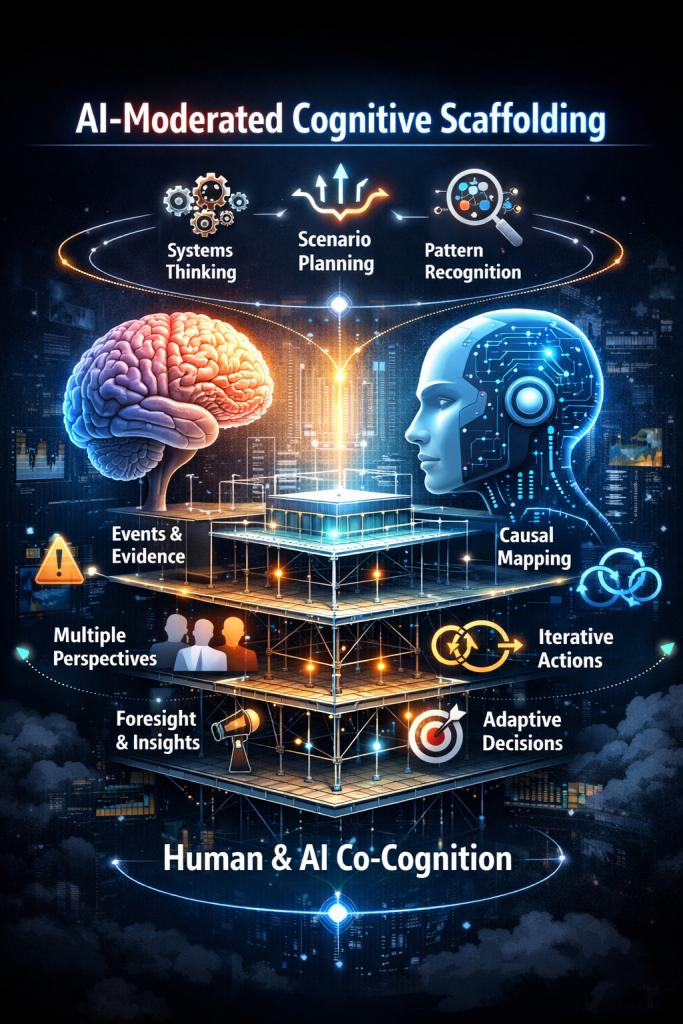
The growing emphasis on systems thinking, strategic foresight, and structured reasoning reflects a deeper realization: the complexity of modern environments has exceeded the natural limits of individual human cognition. Frameworks such as systems thinking, causal mapping, and iterative decision-making were developed to extend human thinking capacity—to help individuals move beyond symptoms and engage with underlying structures.
However, these thinking models were designed for a world in which cognition was bounded within the human mind.
That condition has now fundamentally changed.
Artificial Intelligence does not merely support these thinking models. It moderates them. And in doing so, it transforms the very architecture of thinking—from an individual activity into a distributed, scaffolded system of cognition.
The Limits of Human Thinking Models
Thinking models such as:
systems thinking
multi-perspective analysis
pattern recognition
foresight and backcasting
were always compensatory mechanisms. They exist because human thinking is:
linear rather than systemic
biased rather than neutral
memory-limited rather than expansive
slow in iteration
Even highly trained professionals struggle to consistently apply these models in real-time decision environments. The gap between knowing a thinking model and operationalizing it under pressure has always been significant.
This is where AI introduces a structural shift.
AI as a Moderator of Thinking
AI should not be understood as a replacement for thinking, nor simply as a tool that improves productivity.
Its deeper role is this:
AI moderates thinking by structuring, expanding, testing, and stabilizing cognitive processes.
This moderation happens across all major thinking models.
When individuals attempt systems thinking, AI helps map relationships and feedback loops.
When multiple perspectives are required, AI generates viewpoints beyond the individual’s experience.
When foresight is needed, AI produces alternative futures rather than a single predicted outcome.
When decisions are made, AI enables rapid iteration and scenario testing.
In effect, AI prevents the premature closure of thought, a common limitation in human reasoning where individuals settle on the first plausible explanation or solution.
From Thinking Models to Cognitive Scaffolding
To understand this transformation, it is useful to move from the idea of thinking models to the concept of cognitive scaffolding.
Traditionally, scaffolding refers to temporary support provided to learners until they can perform independently. In professional contexts, this concept extends to frameworks, tools, and methods that guide thinking.
With AI, scaffolding evolves in two critical ways:
1. It becomes continuous rather than temporary
2. It becomes interactive rather than static
This leads to a new form:
AI-mediated cognitive scaffolding: a dynamic structure that augments, stabilizes, and extends human thinking in real time.
Integrating AI into the Extended Cognitive Process
A structured way to understand this is through an extended cognitive flow:
Events
Evidence
Input
Processing
Output
Insights
Decisions
AI moderates each of these layers, reshaping how thinking unfolds.
Events: Expanding What is Noticed
Human attention is selective and often reactive. AI expands awareness by identifying patterns, anomalies, and weak signals that may otherwise go unnoticed. The result is a broader definition of what constitutes a relevant event.
Evidence: Challenging Narrow Framing
Humans tend to rely on limited or confirming evidence. AI introduces diverse and even contradictory data, reducing the risk of biased conclusions and strengthening the evidentiary base of thinking.
Input: Multiplying Perspectives
Thinking is often constrained by role and experience. AI enables the inclusion of multiple viewpoints—customer, regulator, competitor, internal stakeholder—transforming input into a multi-dimensional construct.
Processing: Structuring Thought
This is where thinking models are actively moderated. AI orchestrates:
systems thinking through relationship mapping
zoom in/zoom out through abstraction control
pattern recognition through large-scale analysis
causal reasoning through structured linkage
Processing becomes less intuitive and more architected.
Output: Translating Thought into Structure
Complex thinking often fails at the point of expression. AI organizes outputs into coherent narratives, frameworks, and models, making insights communicable and actionable.
Insights: Moving from Reaction to Anticipation
AI enhances foresight by generating alternative scenarios and identifying unintended consequences. Insight is no longer limited to understanding what has happened, but extends to what could happen.
Decisions: Enabling Iterative Judgment
Decisions are traditionally constrained by time and uncertainty. AI enables simulation, stress-testing, and refinement, allowing decisions to evolve rather than remain fixed.
The Emergence of Distributed Cognition
The integration of AI into cognitive scaffolding leads to a fundamental shift:
Cognition is no longer located solely within the individual. It is distributed across the human–AI system.
This has several implications:
Thinking becomes iterative rather than sequential
Understanding becomes multi-perspective rather than singular
Decisions become adaptive rather than static
The individual is no longer just a thinker, but an orchestrator of cognition.
,z
From Support to Architecture
The most significant implication is conceptual.
AI does not simply enhance thinking models. It transforms them into components of a larger system:
Thinking models define what good thinking looks like
Cognitive scaffolding defines how thinking is structured
AI moderation defines how thinking is sustained and extended
Together, they form a cognitive architecture.
Within this architecture:
systems thinking is continuously enforced
perspectives are automatically expanded
assumptions are regularly tested
decisions are iteratively refined
This represents a shift from episodic thinking to engineered cognition.
Conclusion: Redefining the Nature of Thinking
The traditional view of thinking places responsibility entirely on the individual. The emergence of AI challenges this assumption.
What is now possible is not simply better thinking, but designed thinking environments in which:
limitations are mitigated structurally
complexity is managed systematically
intelligence is co-produced
Thinking, in this new context, is no longer an isolated mental act. It is a system—designed, scaffolded, and moderated.
This shift has profound implications for management, education, and leadership. The competitive advantage will not lie in who can think better in isolation, but in who can design and operate superior cognitive systems.
And in that transformation, AI is not the thinker.
It is the moderator of thought.